Sequeira Lab Published PhysMove: An Open-Access R Package for Movement Ecologists
Introducing PhysMove, an R package and practical guide to help biologists apply statistical physics methods to animal tracking data.
Led by our Postdoctoral Fellow Hannah Calich and Assoc/Prof Ana Sequeira, together with Jorge Rodríguez, Víctor Eguíluz, and Charitha Pattiaratchi, the paper, "Investigating animal movement and behaviour with statistical physics methods: a primer for biologists," was just published in Movement Ecology!
Advances in telemetry and biologging have transformed our understanding of why and how animals move. Despite these advances, methods to quantify universal properties of animal movement, including approaches that have long been used by physicists and mathematicians, remain underused in ecology. Our paper and R package set out to change that.
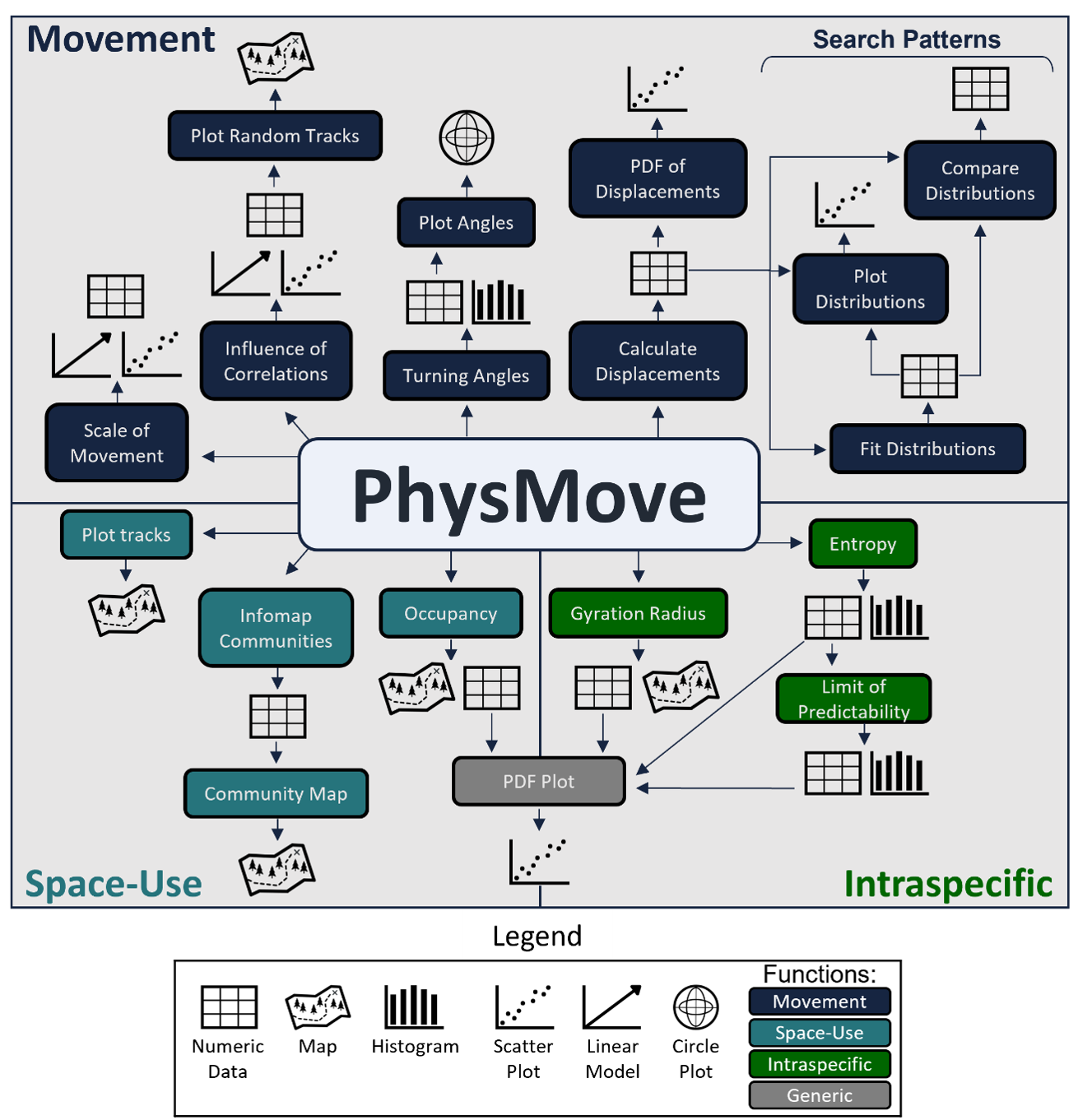
PhysMove packages ten core movement metrics into a single, accessible R package, spanning movement patterns (e.g., scale of movement, search strategies), space-use (e.g., community-wide movement), and intraspecific variability (e.g., predictability and entropy). These methods can be applied across a wide range of spatial and temporal scales and don't require interpolated tracking data. The diagram below outlines each function and how they connect, and step-by-step vignettes with sample data are included to help users get started.
PhysMove makes these methods more readily accessible for ecologists and provides a new way to explore intrinsic properties of animal movement building on approaches applied in some of our previous studies (see for example Rodríguez et al. 2017, Sequeira et al. 2018, and Calich et al. 2021).
Congratulations to Hannah on her leadership of this work, and to all co-authors for a great paper! The paper is open access and the PhysMove R package is available on CRAN. You can also explore PhysMove here: GitHub!